
I have a confession to make. When I started my conservation journey, I wasn’t convinced that communications was the way to go. I didn’t think I could have a tangible impact on the issues that were important to me. I felt I had to completely retrain and ignore the skills I had developed over the last 20 years. I wanted to be ‘hands-on’, I wanted to be ‘in the field’. I thought that people who have real impact worked in forests, savannahs, or on boats. Of course, many do, but that doesn’t mean there aren’t other ways to drive change.
Before I get onto my epiphany moment, let me share another confession: I had lost faith in communications as a medium.
That’s a big statement for a communications consultant! So, allow me to add some context. I knew that comms could be extremely powerful if done right. I had seen that proven time and time again over my career, but it wasn’t for me anymore. The thought of talking about the latest technology, car, pizza, insurance policy, or the world’s best [insert product/service/event here] filled me with dread. I knew it was time for me to find something that I was truly passionate about and pursue that instead.
Finding My Path
For the purposes of this article, let’s fast forward through my career change journey to the point where I knew what I wanted to do. But that journey was not an easy one, and I had lots of help along the way, but I’ll write about that another time. Back to the story: I knew I wanted to work for purpose-led organisations, whether in conservation, animal welfare, or simply focused on being part of the solution rather than the problem. But I didn’t know what I wanted to do within that world. I thought I had no transferable skills, which seems ridiculous now, but that was my thought process.
My first instinct was to return to education and retrain in some of those ‘hands-on’ roles I mentioned earlier. But, thankfully, I first sought the opinions of those already in the sector. Like any good communicator, I did my research before making any big decisions. Those conversations were invaluable, and I continually heard the same thing: communications is a vital part of the world I wanted to break into, and someone with my experience had a crucial role to play.
I heard it, and it made sense, but I wasn’t wholly convinced.
The Moment of Realisation
Then, two things happened.
Firstly, my volunteering ramped up. I committed to several volunteer roles to build experience and because I was passionate about the causes. However, I quickly realised that I couldn’t escape my communications background. As soon as people knew what I did, they had a project for me, asked for my help with a campaign, or hoped I could train them or spread the word about the fantastic causes I was now involved in.
This led to some serious second thoughts. Had I walked away from communications without fully appreciating its value in a biodiversity crisis? Around this time, Sir David Attenborough said, “Saving the planet is now a communications challenge.” That statement made me question everything. It made me realise that all those experienced people I had spoken to were right; communications really was vital. But my epiphany was still to come.
That moment came while volunteering at the Brighton Dolphin Project (now Sussex Dolphin Project). It was an issue that influenced my career choice and, to be honest, my life.
When Communications Became a Necessity
I had been volunteering at the project for just under a year, working with a passionate team that was breaking new ground researching the cetaceans that live along the Sussex coastline. It was a joy to witness these dolphins and porpoises firsthand, both in the water and through videos and images sent in by the public.
Then winter came, and horror replaced wonder. Instead of videos of wake-riding pods, we saw dead dolphins washing up on our beaches. Some had tails, beaks, and fins cut off; others bore net scars, ropes tied around their tails, or were too decomposed to determine the reason for their demise. But one thing was clear: humans were responsible.
The cause of the deaths was clear: they coincided almost perfectly with the presence of supertrawlers in the area. These vast industrial fishing vessels deploy nets up to a kilometre long, indiscriminately capturing everything in their path, removing vast amounts of biomass from the marine ecosystem and causing disgusting levels of bycatch, including dolphins, killed and discarded without consequence.
I realised this was allowed to happen because no one knew about it, and i could help with my communications experience.
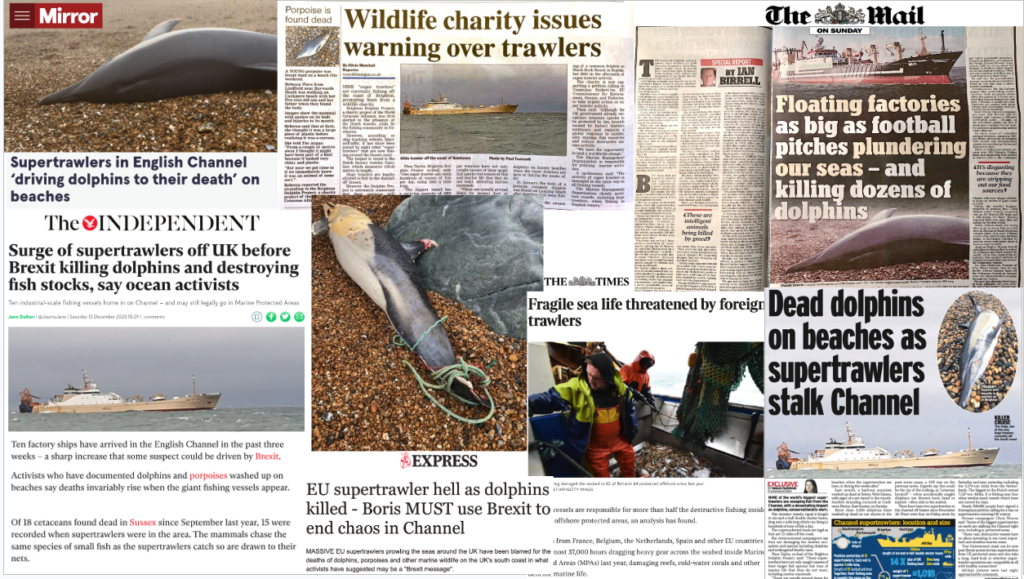
Some of the media coverage published as a result of our supertrawler campaign that first winter.
Using My Skills for Change
That was my epiphany.
I contacted experts, including John Hourston of Blue Planet Society, who became an invaluable mentor. Along with my colleagues, I delved into legislation, fishing rights, and industry practices. We spoke to local fishers who shared our frustration, and we pressed legislators on how supertrawlers could operate with this level of impunity.
Then, we took the issue public.
We reported every supertrawler sighting and documented every dead cetacean in the press and shared the heartbreaking images on social media. The story reached national news, and we were interviewed repeatedly. Our efforts were making a difference. We grew the campaign, welcomed other NGO partners, monitored the vessels at sea and at their home ports. We developed a campaign that later became known as ‘Dolphins Aren’t Discard‘ which is driving change.
Why Communications Matter
That campaign, that moment of anger, and the understanding that action could influence what seemed like an insurmountable issue made me realise that communications is vital for conservation and purpose-led work.
From raising awareness to educating on solutions, from influencing policy change to driving fundraising, recruiting volunteers, and building a network of advocates, communications is the catalyst for meaningful action.
There are many ways to make a difference, and I’ve found mine. I fell out of love with communications because I wasn’t passionate about the stories I was telling. That has changed. Being a storyteller with purpose is my chosen career path, and I am passionate about every story I tell.